Friday, March 4, 2011

traditional

 While the total look of this quilt might not be traditional, the piecing and applique is. The checkered blocks, the flying geese (the triangles), and layered applique to create a flower, plus the simple line quilting stitches would qualify this quilt as traditional (in my humble, but often wrong opinion).
 To me, this is gorgeous. While it's machine quilted, it's traditional in the sense that it's a plain color fabric and the design is all in the stitching. Even the green leaf is created by stitches with a green thread. I think this type of quilting is beautiful because it shows off the quilter's handiwork and not their math or patience skills.
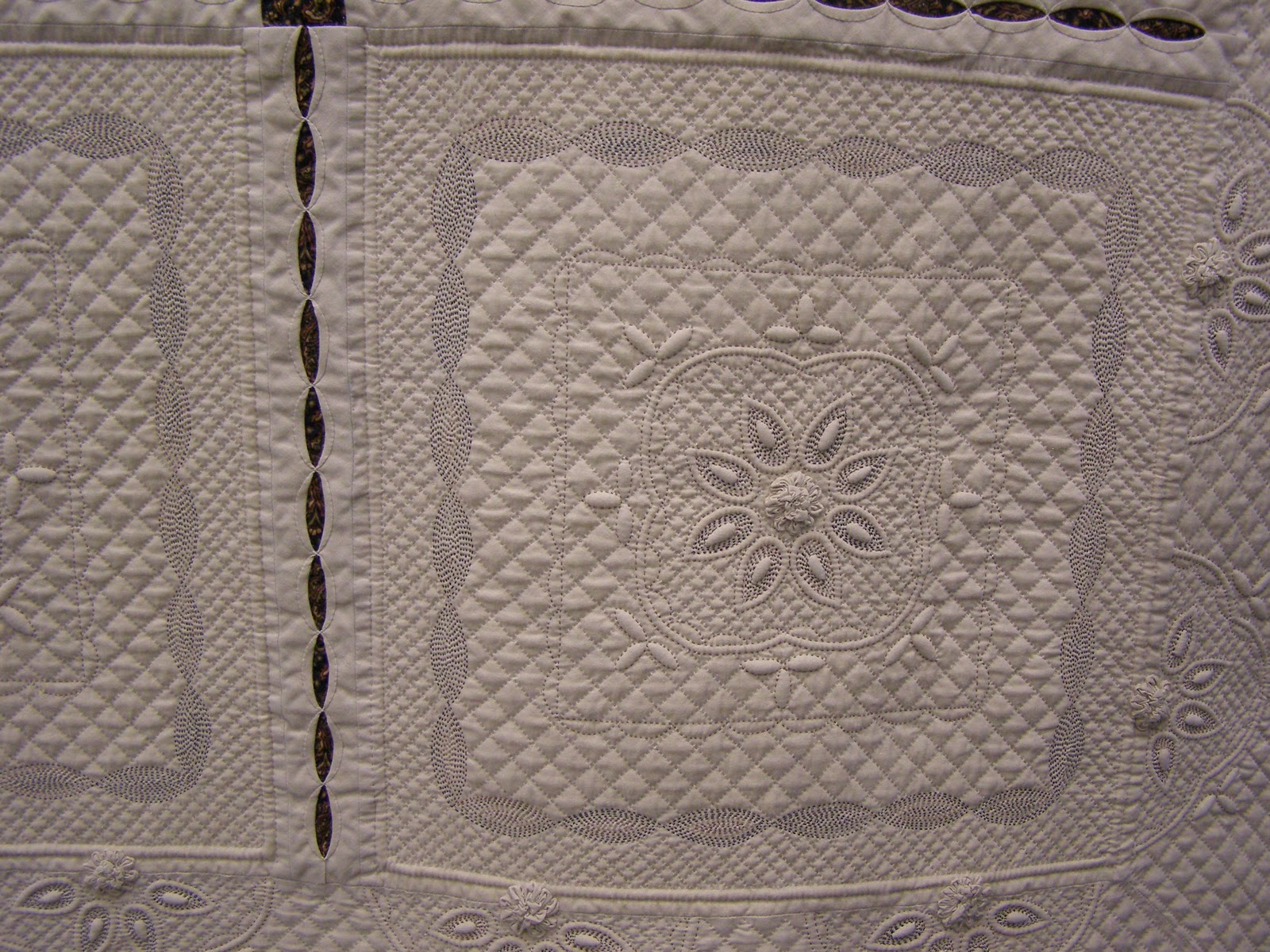
The above quilt (this is the lower 1/4) mixes two traditional quilt styles.  The wholecloth quilt (like the first rose you saw) is where you take one fabric and use the one color of thread and the entire quilt is simply stitching...no piecing or applique. The little bit of color you see to the left (which intersected the quilt into four wholecloth quadrants) is called cathedral quilting. I've never done it, but it involves sewing two pieces of fabric together, cutting one layer, folding the fabric back and stitching each individual cut piece. My mother-in-law, who makes gorgeous, traditional,  pieced quilts started one many years ago and got so frustrated at the time and labor involved she turned what little she had done into a pillow. I say I want to do a cathedral window quilt, but in reality I probably never will.
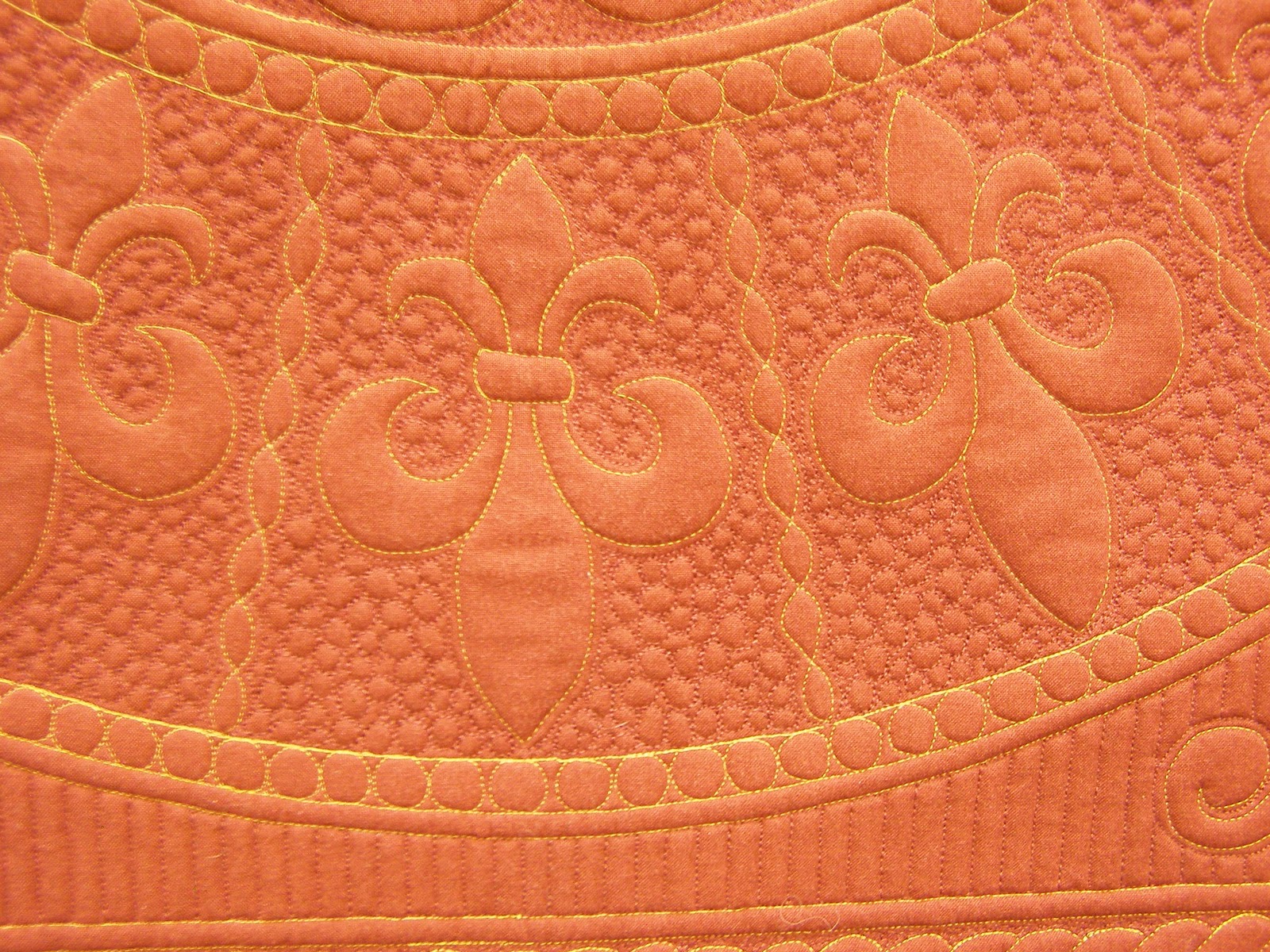
 Another wholecloth quilt that I LOVED, but was disappointed in the picture. It was directly under the light, and even after four photo attempts I still couldn't get the color right. The background fabric is actually a deep maroon, and the quilting a pale orange. It was absolutely stunning.
 And a close up of the fleur de lis and surrounding details.
 A minimum of four different quilt patterns in this quilt!
 I LOVE the colors in this quilt.  This is a patchwork quilt where each block is a different pattern (or at least four different patterns but all in different colors so it looks different). With all the sunlight we have in our house I would be terrified the black would fade, but I love how it makes the colors pop even brighter.
 And this is a modern, whimsical touch using the wholecloth pattern. Someone spent a LOT of time on this.

 And another one of my favorites. Notice the green ribbon?
 Red and white patchwork. I think there may be another name for this style of quilt, but I can't think of it at the moment. I dream of one day making a quilt in just two colors.
 I think I'll pass on embroidery, though. Maybe I could convince my sister and Mom to do it again for me?
 Again, stunning, vivid colors! I'm not sure whether or not the black lines in this quilt would be considered traditional piecing or the newer stained glass window applique people are doing, but I love the way the black frames everything!
 a close up look of the detailed, small block pattern
 The style of this quilt reminds me of the Baltimore patchwork quilts (except it's applique). Every square is different and represents something. In the case, one of the Colonial Quilters Guilds has done historical ships that came to America.

Thursday, March 3, 2011

geometric designs

Below is a pattern that you commonly see in Amish quilts (but without the prints and in a full size).  When the blocks and colors are lined up correctly, it gives a scallop look. I was amazed at the difference made when the same pattern was used with a mixture of prints and solids. And it opens up a few possibilities on what I might do with some fabrics I have. :)

And a close up of the print.

 Quilts like the one above always intrigue me. The last quilt shop I went to with my mother-in-law had quite a few of this style on display.  She commented, "Quilts aren't what they used to be."  I don't know if it's the influence of modern art or the increasing number of men who are engineers that have joined their wives in quilt making that have made the difference. But I like it.
 The above quilt was a blue ribbon winner. It was in a section with a lot of other "modern" (i.e. strange in my book) quilts, but I loved this one and could see it in my house. I like the colors, the dots, the lines, and the quilted swirls. It makes me think of music.

The quilt below is another example of geometric designs that have influenced the world of quilts.I'm giving you the overall view of the quilt first. I like how it seems to be moving.
 
 Quilts are pieced in small sections called squares.  If you look closely above, you can see four squares that meet (look at the yellow, red, darker yellow, and orange bursts that meet on their flat sides and the surrounding area).  Once you break it down like that, the pattern doesn't seem quite so busy.  So how did it get to be so chaotic?

 You change the squares! Notice the small red square placed in the center above?  That throws all the squares off balance.  Same pattern, just adjusted with one very small square.
 I also like the swirls quilted around the circles. It reminds me of heat rising off pavement and adds to the movement feeling.
I'm not a big fan of the above quilt. The colors are not my favorite, and it's a little too Dr. Seussy for me. But I do like how you can make something flat like fabric appear to be dimensional, just by the way you use color and blocks.
And this just made me smile. The fan pattern is a VERY traditional quilt. This quilter flipped the fans in different directions and tilted the inside blocks at an angle, giving it a very different feel. The outside border is also flipped backwards, as well as curved. I love this, though I know others hated it.

Quilting ain't what it used to be. I don't know whether or not the geometric craze in quilts is a trend that will last or that others will look back on and shudder, but I think it fits our time, as well as makes life a little interesting.

Wednesday, March 2, 2011

portrait quilts

One of my graphic design teachers at Wake Tech would start off each semester saying, "I am an artist.  The computer is just one of my many mediums that I use."  In other words, we should view the computer just as we would a charcoal pencil or paintbrush...simply a tool.  Machines, specifically sewing machines and computers, have radically changed the world of quilting. One of the new trends in quilting is portrait quilts. Using the computer and photo editing software (or for that matter even old fashioned tracing paper), you can break a photograph into color blocks or segments, pick out matching material, and quilt the scene. To help make things a little bit faster and easier, the fabric is machine stitched on top of another fabric but WITHOUT the edges being turned under (a cheater's version of applique. :)  This works great for quilts that are meant to be art or wall hangings, but not physically used.
Here's some examples:

One of my favorites. You can't really tell in the photo, but the bird has imitation feathers, costume material, sewn into its body.

Not greatly noticeable in the picture, but the lamp is actually stuffed like a pillow.  My favorite parts about this quilt is the quilting at the top of the dome, and the waves and smoke in the pool.

This one was one of my favorites. It's actually part of the "political - homelessness" exhibit section which I'll talk about another day - but I loved the details and how it looks exactly like a photograph. It's based off a pictures from New Orleans.

I dream of making a quilt similar to this one day.

Notice the blue ribbon! One section of the exhibit were quilts showcasing people. This quilter showcased an African-American painter. I wasn't overly impressed with the paint tubes (had it not been for the paintbrushes I might not have guessed what they were!) but the details in the face were absolutely astounding, especially the glasses!

Sometimes we focus on the big picture so much we don't notice the important details. This is machine quilted, but simply by moving the stitches so VERY close together, in a color that doesn't match the background (on the lips and cheek and nose), it adds texture and shadowing. So many little details, but without them the big picture wouldn't be there!

And a close up of the nose!  Noses were always hard for me to "draw" (my art teacher says you don't draw noses, you simply shade other parts of the face to make it look like a nose) so I really liked how they used different colored fabric and the direction of the stitches to make the nose. (See how the nose stitches are rounded instead of vertical lines?)  And the glasses: In traditional quilting you only use cotton. Art quilts are using a lot of iridescent materials such as toile and thin nylon to create the illusions of glass and water. Impressive indeed!

Another example of a quilt using non-traditional material to make something work.

See the see-through fabric?

And notice the edging stitch on the arm. That's a machine button-hole stitch, which would probably hold up quite well in a washing machine.  If it weren't for the amount of thread it takes to outline a pattern that way, that would certainly be a viable applique option.


Love this one! Reminds me of LA (lower Alabama). And guess what kind of material the Spanish moss is made of?  Thread - a simple zig-zag stitch on the sewing machine done over and over and over and over.

I LOVE this style of quilt!  One lady behind me sighed and said, "Some people must not have a dog to walk or a husband to feed." I think I succeeded in not laughing! But one day I will tackle a quilt like this!


This is a close up of the dog's belly. See how many different fabrics they used? And I love how they used a different color of thread in big messy loops to created shading instead of trying to add another fabric. It looks so messy up close, but from a distance it truly works!

This one STILL has me aghast! FIVE quilts within a quilt! And the flowers! That's what you call watercolor landscaping and is NOT easy to plan out (not that I've ever tried it, but just the thought of it!). And get this...the inspiration for this quilt? A jigsaw puzzle based on a picture from Amish country.

I've always thought those hand-made fabric-covered bulletin boards with ribbons were cute and very creative. But I would have NEVER dreamed to take a picture of one with a picture in it and then duplicate into a quilt! My brain is trying to warp just thinking about it. And the little button/thumbtack things....those yo-yo circles that our friend Sara likes to make!

Another blue ribbon winner, and one that had EVERYBODY talking about! Absolutely incredible, from the planning, to the execution!

Dear to my heart because I've been there, but also really cool because of the details in the quilting, as seen below.

The ridges to form the gaps in the wall?  Simple small strips of a darker fabric!  But look at how TINY the edges are on the cuts in that tree!  Not sure my fingers would allow me to see past the machine needle to stitch that!

And I've seen this brick fabric used many times, but the fact that she outlined EVERY SINGLE brick, really makes it stand out as bricks from a distance.

And the quilt subject with the quilt. She was so honored and so proud. One of the local VA guilds took her picture while she was working in the restaurant upstairs the previous year. The lady was laughing because they even included her job's id badge around her neck! Not often you get to see a live subject beside a quilt!

one day.

Tuesday, March 1, 2011

applique

For those of you not familiar with quilting, applique is where you take one piece of fabric and sew it on top of another (instead of matching the ends of the two fabrics). In quilting, there are four styles of applique that I know of, though I don't know the name of any of them. One style, seen here, gives the pattern a folksy, country, or kiddie feel.  Often quilts for children that have bugs, butterflies, dragons, or the traditional Sun Bonnet Sue quilts will employ this technique. A lot of machine applique also uses it. Quilts done in this style are not for heavy duty use (or machine washing) as the edges can still ravel. But as wall hangings or on beds that are seldom used, this is an easier method that has a gorgeous result.

I loved the bright colors in this exhibit quilt, which is both pieced and appliqued.
Here's a close up of the applique. You can tell it is machine stitched by the
consistently even stitches and the way it leaves gaps in the top material.
Another style is what I learned in class last year. I think it was called a blanket stitch but I'm not sure. The stitches are supposed to be hidden, so you only see the finished "picture".  Here's an example from the Quilt Show:


I was so impressed with this quilt! you don't see the stitches on the fish, it has perfectly rounded corners (which are hard to do!) plus extremely small circles!  Look at that eye! I can't help but wonder whether or not fabric paint or a polka dot swatch was used for the white point of the eye. Or maybe an embroidered french knot? I also adored how they embroidered the name of each fish on the quilt.
It's possible the fish itself (the different colors) was pieced, but it was clearly appliqued onto the back fabric!
The next display quilt is one of my favorite styles. I  hope to attempt something similar one day, though it certainly won't be this pattern. I overheard one lady pondering how many years it took for these quilts to be made, and all I can say is "This one took quite a few."  (unless that was all she did for months upon end)


I also saw a form of applique I had never heard of before (and also want to try one day...big surprise, huh?). It's called reverse applique.  I youtubed it this morning and think it is doable (though again, I wouldn't do this pattern).  It's just as much work as the normal applique, but I think it gives the quilt a dimensional feel.

Can you tell how the bird looks like it's sewn beside the fabric instead of on top of it?


And last, but certainly not least, another of my favorite display quilts. This one employed all different styles of quilting, including various appliques.


Notice how the outer circle is on top of the quilt but you don't see stitches?  That's your basic applique. But see how the center of the sun is below the rest of the material?  That's reverse applique...So cool!

and a close up of the sun with it's sequins
More basic applique, but I love how they used a yo-yo for the flower,
adding dimension (as does the folded fabric next to it).
And I'll take about new trends of stitching in quilts tomorrow (this is one of them), but I love how the colored thread on a dark background gives this quilt an embroidered look from a distance. You don't see the threads too far away, (see the first pic of this quilt and you won't see it at all), but it pops when just a step or two away.
There is one other type of applique being used in modern quilts, but since it used mainly in another genre it'll be showcased on another day. It is a time saver, but means the quilt can only be used as art and is not washable. I hate to make something so big that is not practical. That seems to defeat the purpose of quilt. I like for things to be both beautiful and functional. So I hope you've enjoyed day one of the "good" quilts from the Mid-Atlantic Quilt Festival.

Wait...it's almost March?!?

 10 more months 'til Christmas. This last month has been an absolute blur. Cleaning at Mrs. Bryan's house, cleaning at our house, lo...